
A Change-First Framework for Cosmic Time, Averaging, and Cosmological Inference
Cosmology builds an account of the universe from observations made within it. Signals travel from distant sources, pass through intervening regions, and reach instruments whose readings must be calibrated and compared. How do these different physical histories support one inferred cosmic history?
Relational Tempo Cosmology investigates that question through clocks, relativity, averaging, and the cosmological fitting problem: how a simplified model should be related to a structured universe. It asks whether the translation between regional histories and a common cosmological description can conceal differences that matter for inference.
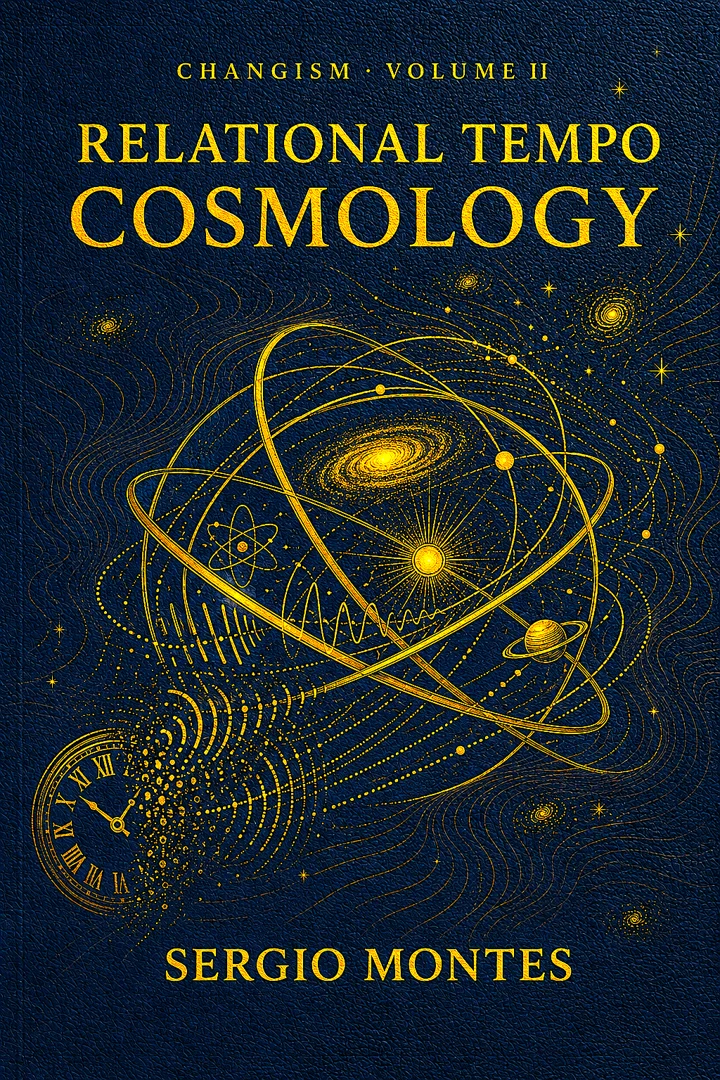
What the Book Develops
The book begins by separating physical processes, their objective relations, and the frameworks through which those relations are compared. It then traces a route from individual clock counts to networks of signals, calibrations, and records.
Its cosmological discussion examines the standard construction of cosmic time, relativistic averaging, and timescape cosmology as a predecessor. The formal chapters introduce tempo comparisons and the conditions under which a relational framework could support a determinate model. Philosophical comparisons with dependent origination and relational quantum mechanics help explain the motivation without supplying the physical model themselves.
The empirical chapters ask what regional or environmental effects would have to look like in observations. They examine apparent acceleration, differences among inferred expansion rates, rival explanations, and tests involving supernovae, gravitational-wave distance measurements, redshift drift, and other cosmological probes.
The book develops a research programme whose physical proposals require calculation and testing. It does not establish that dark energy is unnecessary or that a change of clock convention resolves a cosmological discrepancy. A successful model must earn its support through the observable relations it predicts.
Who It Is For
This volume is intended for readers interested in cosmology, relativity, philosophy of science, and the construction of testable theories. The demands vary: the conceptual chapters explain the questions in prose, while later chapters and appendices require greater familiarity with mathematics, cosmology, and statistical inference.
If those subjects are new to you, Volume I, Part III provides the gentler introduction.
How to Read It
Begin with the preface and the brief guide to the six levels of argument. These explain how the book distinguishes ontology, interpretation, framework, model, empirical hypothesis, and test.
For the physical development, read Chapters 1–3 and then Chapters 6–12. For the observational proposals and their rivals, continue through Chapters 13–17. Chapters 4–5 develop the philosophical comparisons; Chapter 18 considers conditional implications for cosmic fate, and Chapter 19 gathers the conclusions.
Appendices A–E provide derivations, a worked toy model, parameter choices, and designs for future simulations and observational studies. They let technically interested readers inspect how an implementation could be made explicit and reproducible.
Sample Chapter
Chapter 1 — Introduction: The Return of the Cosmic Master Clock
The opening chapter explains why a common cosmic time is legitimate in a suitably symmetric model and why applying that description to a differentiated universe raises further questions. It introduces the central proposal and the work needed to turn it into a physical explanation.
PDF · 29 pages · 0.7 MB · Includes supplied front matter
Editions and Purchase
Choose the format and edition that suit your reading. For technical references, check the edition before relying on a page, table, or equation number.
Corrections and Supporting Materials
The companion address for this book is changism.org/rtc. Corrections identify the edition affected, the relevant location, the revised wording, and the date of the change.
Supporting materials may include extended derivations, parameter tables, code, notebooks, simulation instructions, and subsequent papers. Each released item should identify its version and purpose. The research designs described in the appendices do not, by themselves, constitute released software, completed observational studies, or empirical confirmation.
Book Corrections and Supporting Materials